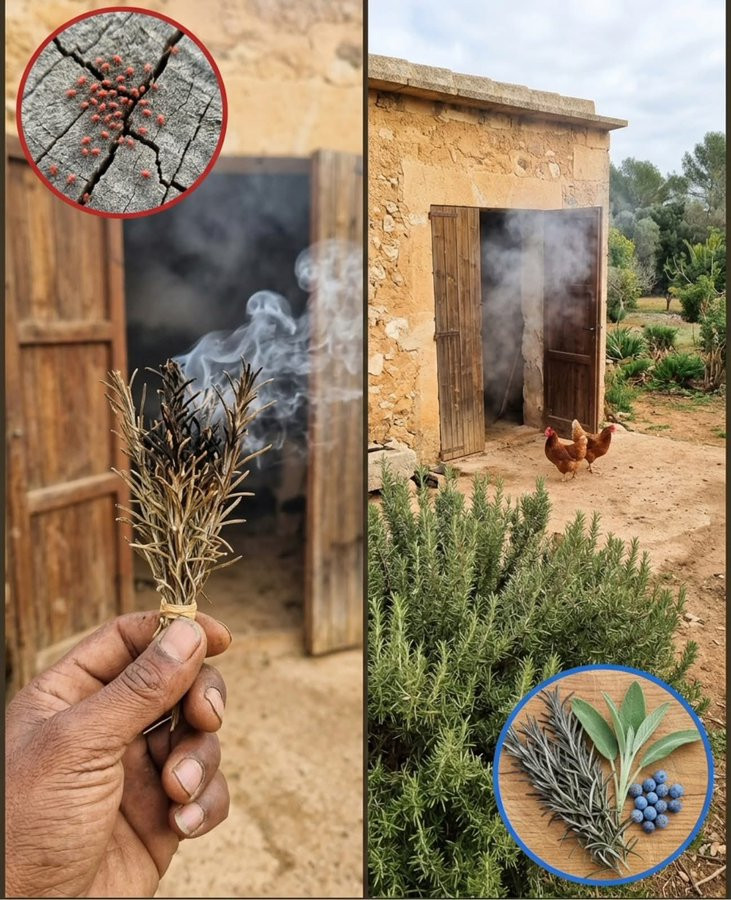
Tips to use against pests instead of health damaging chemicals:
Before industrial disinfectants, Italian peasants and their French counterparts burned bundles of dried rosemary in the stable and chicken coop once a month.
It wasn't a ritual. It was a technique.
Burned rosemary releases camphor, cineole, alpha-pinene, and rosmarinic acid in gaseous form.
In an enclosed space, these compounds reach lethal concentrations for arthropods: flies, mosquitoes, mites, fleas, and lice, without affecting mammals and birds, which tolerate much higher concentrations.
It is this selectivity that made the technique viable in a full chicken coop.
— The red mite (Dermanyssus gallinae) is the most feared parasite in poultry farming.
It hides in the wood cracks of the perches during the day and sucks the blood of the chickens at night.
A heavy infestation causes anemia, a drop in egg-laying, and mortality in chicks.
The peasants fumigated the empty chicken coop (chickens out), letting the smoke penetrate every crack for an hour. The effect lasted 2 to 3 weeks.
Stable flies; Stomoxys calcitrans and Musca domestica, fell within minutes.
Monthly fumigation progressively interrupted the reproductive cycle.
The tradition was not limited to rosemary:
• Dried sage: same active principles, used where rosemary was lacking.
• Dried juniper: resinous smoke effective against flies and mosquitoes, classic in Alpine stables.
• Dried lavender: fumigation of rooms against bedbugs; the burned linalool made the wood cracks uninhabitable.
Fumigation with herbs also played a deodorizing role.
The aromatic smoke masked the ammonia from the manure; a real respiratory irritant for cattle, pigs, and birds. Reducing that concentration concretely improved the animals' well-being. Today, for those managing a small organic chicken coop where chemical treatments are undesirable, burning a bundle of dried rosemary in the empty chicken coop once a month remains a complementary treatment against the red mite: residue-free, no egg contamination, and at the cost of a sprig.